Sunday, December 18, 2016

TOW #13 - Langston Hughe's "Bop"


            Music has the ability to draw people together, or break them apart; most of which depending on the history and genre. Langston Hughes, an American poet most famous for his then-new literary art form of jazz poetry, published the short essay, Bop in 1949. The essay revolves around a young boy, the narrator of the story, and his music teacher, Simple. The two converse about their thoughts on an Afro-style genre of music, “Be-Bop.”  In reference to racial issues during a time of deep segregation, Hughes employs juxtaposition and onomatopoeia in order to highlight the struggle of being a black male in a “white man’s world.” When asked the difference between re-bop and be-bop, Simple juxtaposes the two, saying, “Re-bop was an imitation like most of the white boys play. Be-bop is the real thing like the colored boys play” (Hughes 10). Juxtaposition helps to point out that be-bop was the original, but it was altered to match a white man’s taste, which angers Hughes. The narrator only knows of the altered version because in society, everything that is different from the (racial) norm, is wrong. In addition, while using onomatopoeia to demonstrate where be-bop style originated from, Simple claims that the scatting sound of the music references the brutality that the police put blacks through. Here, Simple says, “’That Negro hollers, ‘Ooool-ya-koo! Ou-o-o!’ ‘Old cop just keeps on ‘Mop! Mop! … Be-Bop! … Mop!’” (Hughes 23). The onomatopoeia represents sounds made by beaten victims, and the hitting by the police. Hughes attempts to inform his audience that sweet music can have an ugly background, especially in a world filled with racial hate. Simple’s music and life advice share a similar lesson of race. Therefore, Simple, similar to the role of Hughes to his audience, converses with the narrator so he can understand the reality of being a black male.


Visual: http://eil.com/shop/moreinfo.asp?catalogid=528062

Image result for be-bop record

Caption: "A Record of Race"

Sunday, December 11, 2016

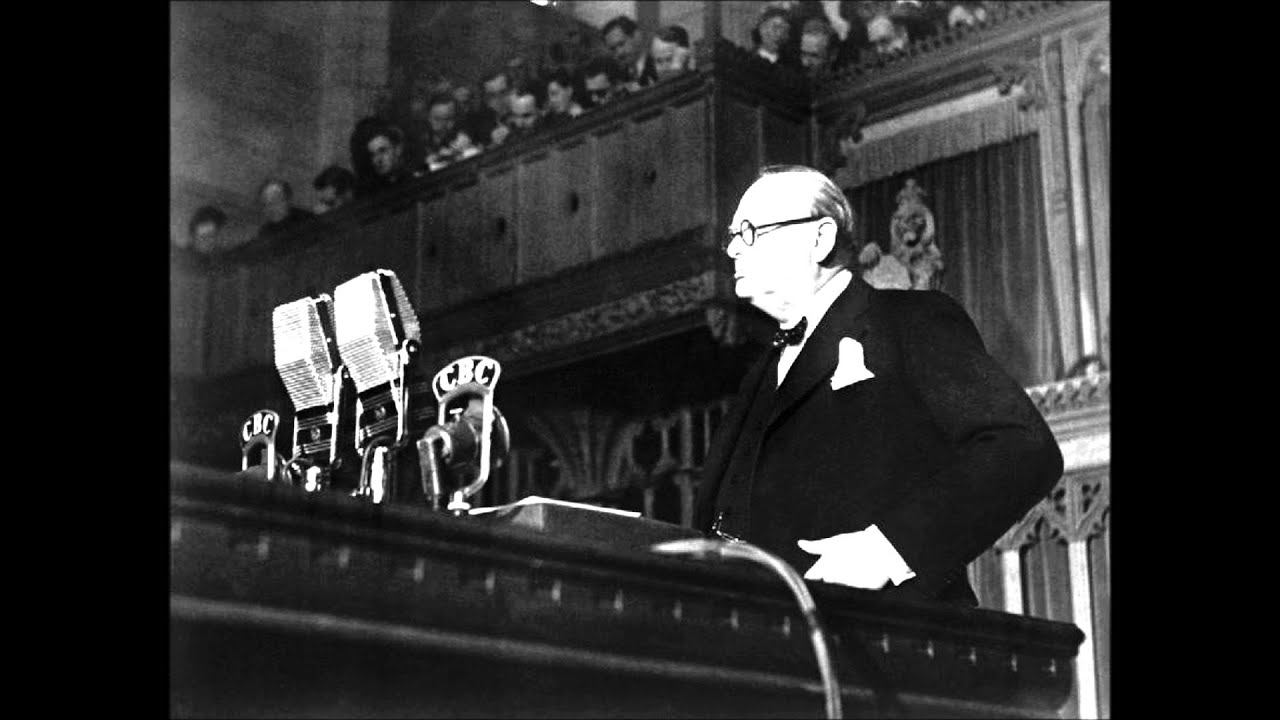
TOW #12 - Winston Churchill's "Blood, Toil, Tears and Sweat"


                Britain declared war on Germany on September 3rd, 1939, after promising to if Germany attacked Poland. That following year, Winston Churchill, former Prime Minister of Britain, was appointed to lead his country in a time of grief. Specifically, on May 13th, 1940, Churchill gave a speech entitled, Blood, Toil, Tears and Sweat, in which he informed the cabinet that he only had his ambition to fight against the Germans, but he was willing to use it all. In the speech, Churchill employs triumphant diction and anaphora in order to prepare the British people for a long battle. As Britain heads in to a time of certain loss, it is Churchill’s diction, ordering for victory, which aids to the British people. After summarizing the roles of the House, Churchill says, “I have nothing to offer but blood, toil, tears and sweat” (Churchill 4). In other words, Churchill does not have the objectives a war, such as weaponry and extreme physical strength; however, he does have the most valuable subjective to succeeding in war, which is mental power. He is honest in his speech, and hopes that his people will fight with all they have, even if it is just the right mind set. In addition to a more fearless message, Churchill also attempts to be realistic with his people by informing them of the road that lies ahead. Using anaphora of “we have before us” he says, “We have before us an ordeal of the most grievous kind. We have before us many, many long months of struggle and of suffering” (Churchill 5). In order to prepare people for an event, especially one that involves great physical and mental endurance, they must know the circumstances. Furthermore, the repetition here emphasizes Churchill’s straightforward briefing, while also implying that the country will work together as one united front. Thus, Churchill’s purpose in informing his people is reached because throughout the war, Britain fought their hardest, and achieved their goal of victory.


Visual: https://i.ytimg.com/vi/8TlkN-dcDCk/maxresdefault.jpg

Image result for blood toil tears and sweat speech

Caption: "Road to Victory (full of blood, toil, tears and sweat)"

Sunday, December 4, 2016

TOW #11 - Sojourner Truth's "Ain't I A Woman"


            Sojourner Truth, a women’s rights activist living during the mid to late nineteenth century, faced many struggles during her lifetime, being an African-American woman. Truth was born into slavery, but escaped with her infant daughter in 1826, where she went on to write speeches arguing her political and social opinions. One of her most famous works is called, “Ain’t I A Woman?”, from December of 1851. In this speech, Truth employs anaphora of her title phrase, and a frustrated diction in order to argue a woman’s distorted meaning in society. Truth’s introduction of the racist and unequal times of society lead up to her use of anaphora. When describing the set definition of a woman, she says, “I could work as much and eat as much as a man - when I could get it - and bear the lash as well! And ain't I a woman? I have borne thirteen children […] And ain’t I a woman?” (Truth 2). As Truth recounts, it is difficult for a woman to get necessities because men come first, with the scarps remaining. Furthermore, a woman can still be abused (“lashed”) even after bearing children for the man. The repetition of her statement toys with the fact that women are defined by such insignificant attributes, including all weaknesses. This attitude of utter frustration carries over on to her diction, when she says, “Then they talk about this thing in the head; what's this they call it? [member of audience whispers, "intellect"] That's it, honey. What's that got to do with women's rights or negroes' rights?” (Truth 3). From the use of the word “intellect”, it is shown that stereotypes do not define a person. Therefore, everyone should have the same rights no matter their intelligence, which may or may not fit the conceived idea society has for that specific group of people. Overall, Truth does not conform to the distorted definition of a person to define that person.


Visual: http://eloquentwoman.blogspot.com/2011/04/famous-speech-friday-sojourner-truth.html


Image result for sojourner truth women

Caption: "Free Lecture!"

Sunday, November 20, 2016

TOW #10 - Hillary Clinton's Concession Speech (text)


                Clinton supporters across the country mourned when the heard that their candidate would not be taking home the presidency. So in response, Hillary Clinton, former Secretary of State, comforted her supporters with a heart-felt concession speech, which she recited on November 9th, 2016 in New York City. The speech covered brief plans to ensure a balanced future for all Americans, and moreover, provided a leg-up to part of the nation. Clinton presents anaphora and an optimistic tone in order to push her audience toward believing that if the whole country comes together, the future will be bright. Anaphora, being the repetition of the word “all”, is used to further bind Clinton’s audience together. She says, “Thank you so very much for being here and I love you all, too […] we are all equal in rights and dignity” (Clinton 1). Clinton’s gratitude shows a genuine concern for her supporters because it is personal. Furthermore, she calls out all Americans, those who voted for her and those who did not, to reiterate the fact that everyone is entitled to basic human rights; those rights are far too important to neglect. The speech continues to lay out a successful path for the nation as Clinton’s tone becomes optimistic. Referring to the idea of having a female president, Clinton says, “I know we have not shattered the highest and hardest glass ceiling, but some day someone will and hopefully sooner than we think right now” (Clinton 3). Here, the highest glass ceiling represents the fact that every president has been a male, but Clinton does not let this stop her. Her tone proves that she has done her part to fight for a female president and believes that it will happen eventually. An optimistic tone from the speaker attempts to amp the audience, causing them to agree, and work for future goals. Overall, Clinton is successful in achieving her purpose because her thoughts are clear, and her passion for the future is represented.   


Visual: http://qz.com/832925/why-did-hillary-and-bill-clinton-wear-purple-during-her-concession-speech/

Image result for hillary clinton concession speech

Caption: "Looking to the Future"

Sunday, November 13, 2016

TOW #9 - Donald Trump's Acceptance Speech

                “Make America Great Again” was the promise that President-elect, Donald Trump, made throughout his campaign. With Trump winning the election, the country has split between those who look forward to his presidency, and those who despise it. Either way, the question remains if the promise will be ensued. In his Presidential Acceptance Speech given in the early morning of November 9th, 2016, in New York City, Trump presents an uplifting diction and anaphora to show that “A Great America” can and will be achieved. Trump uses his diction to try and unite not only the direct crowd, but his audience, the American people; he uses terms such as “united” and “all”, referring to everyone. This message contradicts with the rather discriminatory arguments he made during the campaign, and is viewed as a shocking welcome to the nation. Furthermore, in reference to his slogan, Trump says, “Nothing we want for our future is beyond our reach” (Trump). Trump’s uplifting spirit riots the crowd because every American looks forward to a positive future, and those who cheered believed that Trump can create that. He uses “we” to counteract his past statements, possibly seeking forgiveness, and in an attempt to unify the nation. Trump’s attitude continues as he uses anaphora to give brief plans of what he and his nation are to do in order to make the country “Great Again.” Expanding on this, he says, “We’re going to get to work immediately for the American people […] we’re going to be doing a job, that hopefully, you will be so proud of” (Trump). Here, “we” refers to those who will work directly with Trump, while “you” refers to those who embrace the idea of that work being done. The repetition of “going to” is meant to prove that Trump has a plan, and is ready to take action. Therefore, Trump did achieve the immediate purpose of promising greatness to the country, but the outcome of this grueling process is much yet to be awaited.

Visual: https://www.psychologytoday.com/blog/over-simulated/201107/future-nostalgia-and-defensively-using-the-instant-moment
Image result for the future 
Caption: "The future of our country... awaits"

Sunday, November 6, 2016

TOW #8 - (IRB) "Dear Nobody: The True Diary of Mary Rose" by Gillian McCain & Legs McNeil


            In society, we are taught to want what is best for us. But what if we don’t? What is we don’t care what is hurting us because we are already so far broken? Mary Rose’s philosophy revolved around these same ideas. Dear Nobody: The True Diary of Mary Rose is a non-edited version of the thoughts of a teenage girl growing up in the late 90s, put together by journalists, Gillian McCain & Legs McNeil. In the second half of the novel, Mary Rose continues to struggle with substance abuse, and moreover, relationships. Proving so, she is in and out of hospitals coping with a serious illness, and carries on loving those who refuse to love her back. In the novel, Rose, the original writer, presents an extended metaphor and anaphora in order to show how the love we feel for other people can be stronger than any other force. For example, while describing her closest friends from treatment, Rose uses an extended metaphor by saying, “And all the other angels taken […] you are rarely absent from my mind, and if you ever are absent […] my mind drains into a pit of loneliness and torture” (McCain & McNeil). Rose is comparing those she cares deeply about, to angels. To her, these people are angels because she needs them in her life; they are some sort of light in her life as angels usually are. Without this light, Rose is broken, and unable to move forward. Furthermore, her feelings are synonymous when referring to her ex-boyfriend (at the time), Geoff. While confronting these needy emotions, Rose uses anaphora by saying, “If I ever see him again […] If I ever hear his beautiful voice again […] If I ever touch him again” (McCain & McNeil). Rose proves that there is no need for any other description than her repetition of (some of) the five senses because her passion for Geoff is so strong, the love is all that is needed. Unfortunately, he does not love her back, which is why this constant thought is detrimental for her. Her mind is consumed with his presence, just as it is with the thought of her “angel-like” friends. Thus, the feelings we have towards others are powerful enough to fill our minds, either with a blessing or a curse, unlike any other notion.  


Visual: http://theredpillconsortium.blogspot.com/2011/12/crimson-caplet-power-of-love-love-of.html

Image result for power of love

Caption: "The Power of Love: Good or Bad?"

Wednesday, November 2, 2016

TOW #7 - "I Have a Dream..." by Dr. Martin Luther king Jr.


                Throughout history, the United States has prospered from a nation encountered only by one race to a nation led by freedom and justice; but this fact has taken its time, as well as the peace of people who protested in order to reach this goal of prosperity. One famous protester was Dr. Martin Luther King Jr., who, in the year of 1963, recited a speech entitled “I Have a Dream…”, in which he spoke of the barriers between black men and white men. Moreover, he recounted his hopes of freedom for all people, all races included. In this powerful speech, King presents anaphora, and a passionate simile in order to unite his audience to create a nation of pure freedom. After informing his audience about the issues of the United States, King uses anaphora to mark the point of his speech as “a call to action.” For example, he states “Now is the time to make real the promises of democracy […] Now is the time to make justice a reality for all of God’s children” (King 2). By repeating “now is the time”, King gives his audience multiple chances to hear his words, and do something about it, something that will make change promoting freedom for all. Going off of this, true democracy represents implied freedom, which is a justice for all people. Likewise, King’s further use of the repetition of (non)satisfaction leads into a passionate simile, where he states, “We will not be satisfied until justice rolls down like waters and righteousness like a mighty stream” (King 4). King’s comparison of justice and righteousness to the movement of a stream, is an indirect call for his audience to create a just society that is free from oppression; in fact, so free that justice and freedom simply flow through. Unfortunately, from a current perspective, King did not reach a society where all men share freedom, but his audience, a united nation, did get to see the day where a man could join hands with another, no matter the color of his skin.  

Visual: http://americanvision.org/9232/rhetorical-fluke-providential-king-i-have-a-dream/

Image result for i have a dream speech

Caption: "A Call to Action"