Sunday, February 26, 2017

TOW #20 - Hackschooling Makes Me happy by Logan LaPlante (Visual TED talk)


Reading Education by Emerson gave insight into school, its meaning, and how that meaning is distorted to the disadvantage of the student. However, Emerson was not the only wise mind to propose an ingenious schooling system; 13-year-old student, Logan LaPlante gave a TED talk in 2013 where he also presented similar ideas to Emerson. The lecture entitled Hackschooling Makes Me Happy, LaPlante addressed his connection to happiness, and how his unique “homeschooling” system has helped him to achieve that connection. His philosophy on schooling, I agree with due to his informal and personal tone; this connects him with the direct audience, and students across the country hoping for a different chance at education. An example of this philosophy is exposed when he says, "What if we based education on the study and practice of being happy and healthy?" (LaPlante). In reality, happiness is the key to life, so whatever in life makes one happy, has just reasons to be involved. Education is also a major part of life as schooling typically lasts from ages five to twenty-two, and lessons continue throughout the entire life. Therefore, if society spent those years on preaching the key to life, happiness may be more achievable overall. In addition, LaPlante continues the theme of happiness when he concludes, "If you ask me what do I want to be when I grow up, I'll always know that I want to be happy." (LaPlante). Upon hearing this in his lecture, I smiled. LaPlante, being only a young teenager, does not have much life experience, but certainly enough to realize how vital happiness is to a fulfilling life. When grown up, it does not matter what job one may have if he/she is not happy. Furthermore, his conclusion revolves around happiness rather than the schooling system because happiness comes first, which as LaPlante states, is why it should be a focus point in schooling. In other words, society can “hack” school, “hack” life, to achieve happiness.
Visual: https://outsidetheboxhomeschoolers.wordpress.com/2013/02/15/hackschooling-tedxuniversityofnevada-talk-by-a-13-year-old-logan-laplante/
Image result for hackschooling

Caption: "Hackschooling in a Nutshell"

Monday, February 20, 2017

TOW #19 - "How a Pro-Palestinian American Reporter Changed His Views On Israel And The Conflict" by Hunter Stuart

            The Israeli-Palestinian conflict is arguably like no other, a greater force than that over just land. Much of the time, a person’s opinion on the conflict stems from their religious and/or political views. Justly, an American journalist, Hunter Stuart published an article in earlier February describing his stay in Israel, and moreover, his developed view on the Israeli-Palestinian conflict. Rather than seeing the conflict in the eyes of most Americans, thousands of miles away, Stuart lived through it, marking him as a credible source. In addition, Stuart’s central claim, which is in support of Israel as well as keeping an open mind on the conflict, is in firm agreement with my beliefs. Prior to staying in Israel, Stuart, like many liberal Americans, viewed Palestinians as the “underdog” in the conflict, and therefore was in support of a two-state solution. However, the unfortunate fact, that Stuart remarks is that Israel is surrounded by people who believe Israelis have no place on this earth. He says “Personally, I’m no longer convinced it’s [two-state solution] such a good idea. If the Palestinians are given their own state in the West Bank, who’s to say they wouldn’t elect Hamas, an Islamist group committed to Israel’s destruction?” (Stuart). Stuart aims to highlight the fact that he has seen the behavior between Israelis and Palestinians, and peace is not near reach. It is not as simple as most Americans see it. If Israel loses the Gaza strip, loses Jerusalem, Israel is lost; it rightfully gained that land from the Palestinians, and desperately need it for protection. On the other hand, Stuart’s argument is not biased due to the fact that he explains the importance of keeping an open mind, and looking at both perspectives of the conflict. He remarks, "I guess, at least, I can say that, no matter how socially unacceptable it was, I was willing to change my mind. If only more people would do the same." (Stuart). Both sides, the Israelis and Palestinians, do have valid reasoning as to why certain land belongs to their side, which is why it is necessary to truly seek perspective from both sides. This way, each perspective can be analyzed, and viewpoints can change based on that. Stuart’s mind changed after staying in Israel, something that will stick with him in his travels, and life lessons.
Visual: http://www.jpost.com/Jerusalem-Report/A-view-from-the-frontlines-480829 
Ofer Prison 
Caption: "Stuart in Israel"

Sunday, February 12, 2017

TOW #18 - "Slime Wave" by Tom Avril (The Inquirer)

In the digital era that is today, it is a relief for parents to see their children playing with toys, and exploring creativity. The new phase of playing and crafting for kids all across the globe is slime, also known as ‘gluep’, originating in the 70s and 80s. However, rather than buying slime pre-made, kids are stocking up on glue, and borax, the two key ingredients in home-made slime. An article from “The Inquirer” entitled Slime Wave by staff writer, Tom Avril entails the recent uproar of slime, and argues that slime is more than just a ‘messy toy’ by employing deductive reasoning. First, the article introduces its claim being that slime has productive uses, and then goes on to list the multiple reasons to back the claim up; due to the fact that making slime is considered a craft, the process embraces creativity, and scientists have been teaching classes using slime as a model. A head-marketer at Newell Brands, an organization with relations to Elmer’s Glue factory, stated that he has “been impressed by the evidence of creativity on social media sites” (Avril). Kids invested in making slime are posting recipes online, and sharing their ideas with the web, using the internet for something positive along with using their hands for something crafty. Here, the author of the article backs up his claim with valid opinion from the head-marketer, making his argument even more believable to the audience. In addition, slime has also been used as a learning tool. For example, the article reads, “Under another name, the science museum also has used the substance [slime] for a lesson on the immune system” (Avril). The current slime phase is proving to be more than just a game; this claim is further backed up with information from scientist explaining that since the slime is so appealing to play with, it is making kids more interested in educational lessons when slime is used as a model. Therefore, the article succeeds to prove, through the use of deductive reasoning, that slime, if used properly, can actually be a tool for creativity and education.  

Visual: http://ourbestbites.com/2010/09/kids-in-the-kitchen-slime/ 
Image result for slime
Caption: "Creative goop"

Sunday, February 5, 2017

TOW #17 - The Onion's "Study Reveals Pittsburgh Unprepared for Full-Scale Zombie Attack"

The fear of a zombie apocalypse, while unrealistic, is still fairly relevant to a handful of Americans, entailing why a satirical newspaper, The Onion published an article entitled, “Study Reveals Pittsburgh Unprepared for Full-Scale Zombie Attack” in 2005. Despite the sarcastic tone of all articles from this news source, examples of “zombie organizations and administrators” along with a daunting metaphor do not fail to make the threat of apocalypse possible. These aspects are employed in order to prepare Pittsburgh for an attack from the undead. According to the Zombie Preparedness Institute (ZPI), a mock scientific organization mentioned in the article, “when it comes to defending ourselves against an army of reanimated human corpses, the officials in charge have fallen asleep at the wheel” (The Onion 2). The metaphor describes the government officials, typically thought to ‘keep the state safe’, as the opposite in this case; “falling asleep at the wheel” refers to the officials not paying attention and taking charge of the issue at hand, the threat of a zombie apocalypse. This daunting metaphor aids to warn the audience, citizens of Pittsburgh, that they must take charge to remain safe in times of chaos. In addition, the article uses the words of mock zombie expert, Dr. Milton Cornelius to further describe the state of disaster. Cornelius remarks, “Today’s zombies quickly learn to open doors, break windows, and stage ambushes” (The Onion 4). Cornelius’ description of the zombies’ attributes aids to inform the audience what they will be facing if they do come across one of the undead, so they can be prepared to fight for their lives. Also interesting is the fact that Cornelius states that the zombies are capable of learning, something usually not associated with walking human corpses. Thus, by employing a metaphor, and mock information from zombie experts and organizations, The Onion was able to help prepare the citizens of Pittsburgh for a fight with the undead.  

Visual: http://all-that-is-interesting.com/survive-zombie-apocalypse
Image result for zombie apocalypse

Caption: "Best to be Prepared" 


Sunday, January 22, 2017

TOW #16 - Donald J. Trump's Inaugural Address

On January 20th 2017, Donald J. Trump officially became the 45th president of the United States. This fact angers some, worries some, yet excites others. It is a truth, whether favorable or adverse, that the people of the United States will have to, in some way shape or form, adjust to; not necessarily get used to, but adjust to. On January 20th 2017, supporters and protesters lined Pennsylvania Avenue as Trump took the oath of honor, and give his inaugural speech. During his speech, addressing the entirety of “not-yet-great” nation, Trump employs anaphora and an allusion to religion in an attempt to bring unity. However, the question remains if he will do so. Using the anaphora of “we will bring back”, Trump states, “We will bring back our jobs. We will bring back our borders. We will bring back our wealth, and we will bring back our dreams” (Trump). Prior to the inauguration, people wondered if President Trump would sound any different than candidate Trump. Although it is a matter of opinion, he proves the opposite here as he repeats “will”, implying a plan meant to persuade – something typical for a campaign. On the other hand, he does stress total unity by repeating “we”, referring to every individual of the United States. Going off this, Trump alludes to faith in god as he states, “The bible tells us how good and pleasant it is when god's people live together in unity" (Trump). Some Americans do not view Trump as a leader of unity as they read between the lines of his words. Despite the valuable lessons of the bible and Trump’s attitude toward them, there is a clear separation in the county due to his presidency. Currently, more than being classified as “great” or not, the United States is lacking middle ground, or in Trump’s words, unity. In other words, a strong fire that can bring people of varied opinions back together into a thriving nation; a strong fire that hopefully the new leader can create. 

Visual: http://www.telegraph.co.uk/content/dam/news/2017/01/20/JS118387253_AFP_TOPSHOT-US-President-Donald-Trump-spea-large_trans_NvBQzQNjv4BqY1vlWu6X4ClJ13DpyYGHanCugcTyzyB-SXuPVffSvBI.jpgn 
Image result for trumps inaugural address
"Thumbs for Unity or Separation?"

Monday, January 16, 2017

TOW #15 - Michelle Obama's 2016 DNC speech (text)

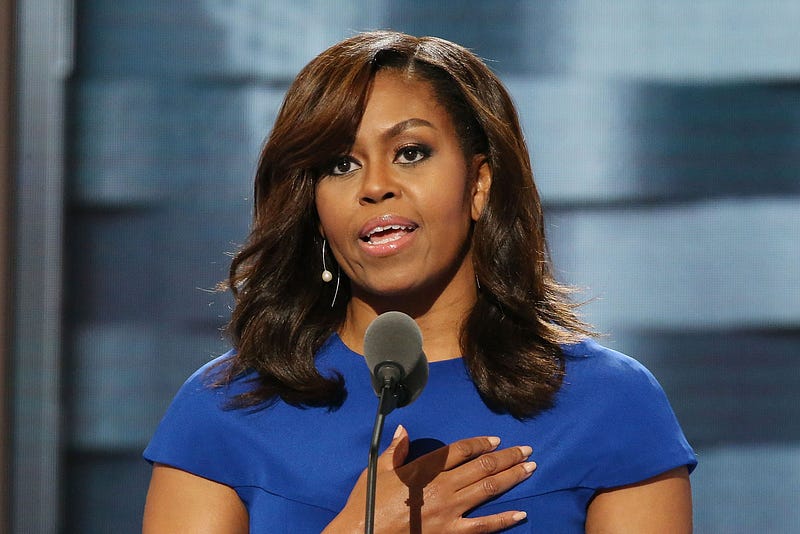
Knowing that the 2016 Presidential Election results were certainly disappointing for some, and at least unexpected, it is interesting to look back at the race, specifically the Democratic National Convention (DNC). During July 25th through July 28th, multiple powerful speeches were made at the DNC in support of Hillary Clinton, but one in particular, by first lady, Michelle Obama, highlights the country’s current strengths and well-bring for all people. In the speech, she employs a personal anecdote and resolute diction in order to emphasize the importance of selecting a leader that is fit for the children. Before jumping straight into her literal message, Michelle connects with the audience with a touching anecdote of her young daughters entering the spotlight. She says, “At the moment, I realized that our time in the White house would form the foundation of who they would become. And how well we manage this experience could truly make or break them” (Obama 4). Her words prepare the audience for a lead into Hillary Clinton, and the reasons why she will be best fit for the future. Without children, there is no future, something extremely difficult for any mother, even one as busy as Michelle, to imagine. Going off her quote, every child will be transformed in some way, partly dealing the country’s leader, so that leader must be strong. In addition, a resolute diction continues when Michelle reiterates, “And when I think about the kind of resident that I want for my girls and all our children, that is what I want. I want someone with the proven strength to preserve” (Obama 11). Hillary Clinton has the proven strength because she not only has raised a child herself, but has continued to raise the country’s children before and after the election race. Michelle wants a leader who can preserve, meaning keep the country stable, and the children innocent and intelligent, just as Michelle and her husband have tried to do since 2008. Thus, with a steady hand and clear thoughts, Michelle leads the country to another vital decision, a decision of the future.

Visual: https://theringer.com/why-michelle-obamas-dnc-speech-worked-so-well-ea6a13f279c9?gi=b53f723972e1 
Image result for michelle obama dnc speech 
Caption: "Preservation" 

Sunday, January 8, 2017

TOW #14 - "The Girl with the Lower Back Tattoo" by Amy Schumer (IRB)


            Amy Schumer, American comedian, is best known for her raunchy stand-up, entailing hilariously inappropriate stories from her past; but what many do not know is that behind the vulgar humor, she is a quiet, small-town girl. In her autobiography, The Girl with the Lower Back Tattoo, she recalls anecdotes from her past that are without a doubt laugh-out-loud. Specifically, in an early chapter entitled, I am an Introvert, Schumer explains why she is “the textbook definition” of one by employing an analogy and simile to playfully mock the introvert stereotype. Schumer begins to define an introvert using an analogy, where she says, “If you’re a true introvert, other people are basically energy vampires. You don’t hate them; you just have to be strategic about when you expose yourself to them – like the sun. They give you life, sure, but they can also burn you” (Schumer 15). Schumer compares introverts to vampires, and other people to the sun because a vampire does need some life, just as all people need others. However, at the the same time, some people value much alone time as it is a time of pure reflection and recuperation, two key aspects to writing an autobiography. In addition, shortly after, Schumer draws on the process of being an introvert and going to public events. Including a humorous simile, she states, “Usually I will find a corner to hide in and immediately begin haunting it like the girl from The Ring, just hoping no one will want to come talk to me” (Schumer 19). Again, Schumer compares an introvert to a frightening creature, which ties into the fact that society views most introverts as company-haters; to counter-act this negative persona, Schumer jokingly exaggerates it to a topic which all people can relate to – public events and horror movies. Therefore, as Schumer gets closer with her readers through personal experience, she also attempts to balance out how some people view introverts due to the fact that she is a proud one herself.


Visual: http://www.thewrap.com/amy-schumer-i-didnt-have-a-perfect-/

Image result for amy schumer

Caption: "The Girl Herself"