Sunday, March 26, 2017

TOW #24 - Cover from Newsweek Magazine (Is your Baby Racist?)

            Some people argue that the roots of discrimination dwell inside human nature, and others revert to the idea that discrimination is a learned process; therefore, a newborn child not yet exposed to racist beliefs, cannot be discriminatory. To take a stance on this issue, Newsweek published a controversial magazine cover, the title being “Is Your Baby Racist? Exploring the Roots of Discrimination”, on September 14th of 2009. The cover also displays a photo of a male Caucasian infant. Due to the questioning, and emotional appeal of the photo, I feel as though the cover argues that discrimination is learned though experience and lesson, and this, I arguably agree with. The thought provoking statement “exploring the roots of discrimination” refers to human nature, this being the root of humanity. By nature, every human being is, more or less, the same. As the saying goes, “we all bleed the same blood.” Therefore, a child not yet exposed to discrimination, is unaware of the fact that humans see other humans as “different” based on external attributes. Furthermore, the abrupt question on the cover almost comes off as offensive to the viewer because it can easily be mistaken as an accusation; that Newsweek is accusing their viewers of teaching discriminatory values to an innocent child. However, the point of this questioning is to make the viewers evaluate the roots of discrimination, and how a parent’s views on discrimination could impact their child’s. For example, if a parent repetitively enforces to their child that all people of any other religion (than their own) deserves to be discriminated against, that child would logically feel uncomfortable around people of another religion. In addition to the phrasing on the cover, the photo shows a baby of a race and gender that, typically, does not face as much discrimination in society. Similar to the phrasing, the photo forces the viewer to internally argue what causes discrimination, nature or experience.

Visual: https://s3.amazonaws.com/files.digication.com/M9426704b5b5063dd1659a4cb984cde35.jpg
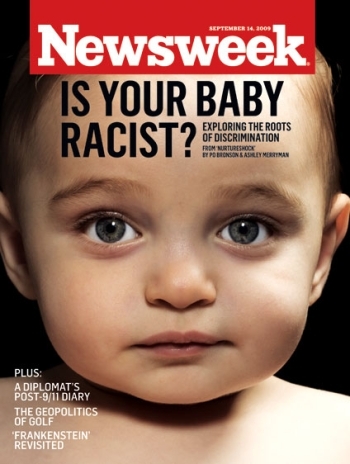
 
Caption: "Discrimination Draws Upon Experience" 

Sunday, March 19, 2017

TOW #23 - Zak Ebrahim's "I am the son of a terrorist. Here’s how I chose peace"

            In modern society, islamophobia, has undoubtedly become a growing issue. This factor connects to the stereotype that a person of the Islamic faith must practice terrorism, or justly, that terrorism in a trend in certain families. Due to the repercussions of these issues, peace campaigner and author, Zak Ebrahim, gave a TED Talk entitled, I am the son of a terrorist. Here’s how I chose peace. In the lecture, Ebrahim argues that a son does not have to be like his father, in order to break the stigma surrounding peace in the Islamic faith. A societal belief is that Muslims and Jews are enemies, and therefore cannot be friends; fortunately, Ebrahim did not let this false hood impact his childhood friendships. He describes, "I had never had a Jewish friend before. And frankly, I felt a sense of pride in having to overcome a barrier, that for most of my life, I had been led to believe was insurmountable" (Ebrahim). The fact that Ebrahim was willing to overlook the difference of religion, and the beliefs his father instilled in him, proves that acceptance is more powerful than family trend (of hatred). In other words, the history does not matter; the ability to forget that history is what matters. In addition, to wrap-up his argument, Ebrahim shares the inspirational tale his mother told him. He says, "She looked at me with the weary eyes of someone who had experienced enough dogmatism to last a life time, and said "I'm tired of hating people."" Her weary eyes represent the hatred that had been placed in her mind for years on end. Hatred is not natural, it is only a concept that is taught, which is what Ebrahim stresses is possible to overcome. The saying “like father, like son” can apply in some cases, but not all, and Ebrahim is proof of this, and that stereotypes do not define a person.


Visual: http://www.halalinthefamily.tv/wp-content/uploads/2015/04/take-on-hate.jpg 
Image result for anti islamophobia
Caption: "Take on Hate"

Sunday, March 12, 2017

TOW #22 - Margarita Engle's "Enchanted Air"


Imagine spending your days trapped in a place that does not feel like home; present is a strong longing to be somewhere else. In the memoir, Enchanted Air, Newberry-honor winning author, Margarita Engle, tells her tale of living in Los Angles but longing for her home country, Cuba. The memoir is styled similar to poetry through the use of stanzas, and takes place during the Cuban Revolution (1953-1959). In the first section of the memoir, Engle describes the beauty and benefit of Cuba – why it means so much to her – by employing a simile of innocence, and imagery in order to captivate what home represents. Engle looks back in time, and embellishes, though the use of a simile, on the first time that her parents took her to visit family and Cuba. She writes, “Already this Island is beginning to seem like a fairy-tale kingdom, where ordinary people do impossible things” (Engle 7). As an innocent child, as Engle is when experiencing Cuba’s air for the first time, the world seems like a magical place; a place filled with color and wonder. Similarly, that is the magical aspect to innocence, that a country has the ability to seem like a “fairy-tale kingdom.” Engle has hope for Cuba because she recognizes that everyone there strives for the impossible, one reason why she feels so comfortable with those people. Presumably, she admires them. In addition, Engle employs imagery when describing the memories of a house in Cuba. She writes, “Cool ceramic floor tiles on a hot day, and an open-air kitchen with roll up walls that are only needed during hurricanes” (Engle 10). The fact that Engle describes the specifics of the house, shows that she has paid close attention, that she cares about the little aspects. She cares because she feels at home in Cuba, and wants to experience all that there is about it, even the floor tiles or walls of a house.
Visual: http://www.esenciaexperiences.com/cuba-travel-ideas-luxury-cuban-holidays/bespoke-1950s-style-havana-holiday/
Image result for cuban home 1950s
Caption: "1950s Cuban Home Style"

Sunday, March 5, 2017

TOW #21 - Tim Urban's "Inside the mind of a procrastinator" (TED Talk)

                For some people, deadlines come easy; go home, do work consistently, and be cool as a cucumber the day before an assignment is due. Unfortunately, deadlines and homework in general, do not come second nature to some people, including myself. In April of 2016, Tim Urban, American internet writer, shared a TED Talk Lecture entitled, “Inside the mind of a procrastinator” where he employs visual metaphors and eye-opening diction in order to convey that there is a procrastinator in all of us, one we may never realize. During his presentation, Urban takes advantage of the digital board behind him, thus using it to literally illustrate the mind of a procrastinator. He does this with metaphors which are meant to represent parts of the brain, and the reasons why a procrastinator procrastinates. Referring to a procrastinator’s decision making process (area of the brain), he says, “An easy and fun place that's entirely out of the "make sense circle"; I call it the "dark playground”” (Urban). Personally, I know it is a frustrating time when the brain switches over to the “dark playground” when it is time to do work, so Urban comforts his audience by relating on this level. However, we are all human, everyone must go on break mode, which is a point that Urban stresses, while employing eye-opening diction, towards the close of his lecture. While presenting a calendar visual of the entirety of weeks in an average person’s life, he states, “I think we need to all take a long hard look at that calendar, and we need to think about what we're really procrastinating on because everyone is procrastinating on something in life” (Urban). After consideration, procrastination is not only involving homework or deadlines, but more importantly, life itself. There is something in life, whether it be relationships, exercise, religion, that people procrastinate on. Therefore, Urban makes a clear point that life is short, so we must not spend our time awaiting it, just living it, and doing what we need to do without hesitation.
Visual: https://www.google.com/url?sa=i&rct=j&q=&esrc=s&source=images&cd=&ved=0ahUKEwjLpYLU7sDSAhXL5CYKHTmcD3oQjxwIAw&url=http%3A%2F%2Fwaitbutwhy.com%2F2013%2F10%2Fwhy-procrastinators-procrastinate.html&psig=AFQjCNGwsNJ7OkrLkdQdSarJEkmINgO37Q&ust=1488854840947111
Image result for tim urban procrastination 
Caption: "Rational Thought Ruined"