Sunday, December 18, 2016

TOW #13 - Langston Hughe's "Bop"


            Music has the ability to draw people together, or break them apart; most of which depending on the history and genre. Langston Hughes, an American poet most famous for his then-new literary art form of jazz poetry, published the short essay, Bop in 1949. The essay revolves around a young boy, the narrator of the story, and his music teacher, Simple. The two converse about their thoughts on an Afro-style genre of music, “Be-Bop.”  In reference to racial issues during a time of deep segregation, Hughes employs juxtaposition and onomatopoeia in order to highlight the struggle of being a black male in a “white man’s world.” When asked the difference between re-bop and be-bop, Simple juxtaposes the two, saying, “Re-bop was an imitation like most of the white boys play. Be-bop is the real thing like the colored boys play” (Hughes 10). Juxtaposition helps to point out that be-bop was the original, but it was altered to match a white man’s taste, which angers Hughes. The narrator only knows of the altered version because in society, everything that is different from the (racial) norm, is wrong. In addition, while using onomatopoeia to demonstrate where be-bop style originated from, Simple claims that the scatting sound of the music references the brutality that the police put blacks through. Here, Simple says, “’That Negro hollers, ‘Ooool-ya-koo! Ou-o-o!’ ‘Old cop just keeps on ‘Mop! Mop! … Be-Bop! … Mop!’” (Hughes 23). The onomatopoeia represents sounds made by beaten victims, and the hitting by the police. Hughes attempts to inform his audience that sweet music can have an ugly background, especially in a world filled with racial hate. Simple’s music and life advice share a similar lesson of race. Therefore, Simple, similar to the role of Hughes to his audience, converses with the narrator so he can understand the reality of being a black male.


Visual: http://eil.com/shop/moreinfo.asp?catalogid=528062

Image result for be-bop record

Caption: "A Record of Race"

Sunday, December 11, 2016

TOW #12 - Winston Churchill's "Blood, Toil, Tears and Sweat"


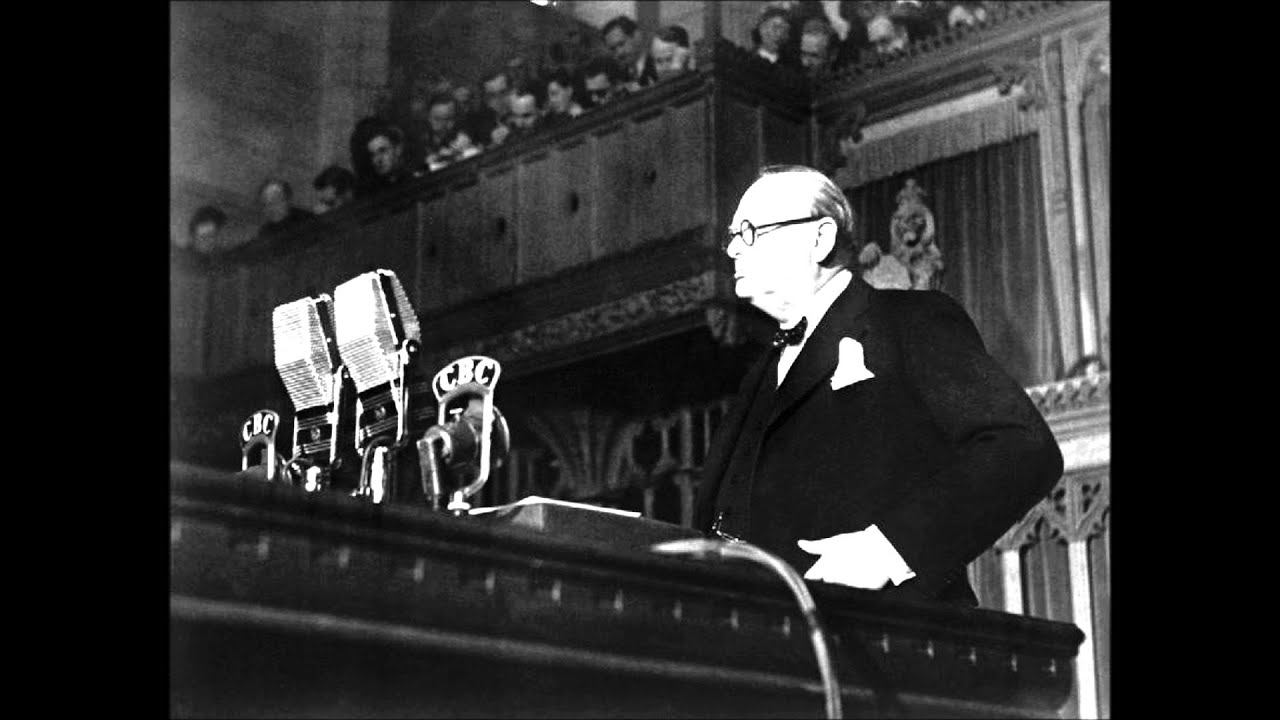
                Britain declared war on Germany on September 3rd, 1939, after promising to if Germany attacked Poland. That following year, Winston Churchill, former Prime Minister of Britain, was appointed to lead his country in a time of grief. Specifically, on May 13th, 1940, Churchill gave a speech entitled, Blood, Toil, Tears and Sweat, in which he informed the cabinet that he only had his ambition to fight against the Germans, but he was willing to use it all. In the speech, Churchill employs triumphant diction and anaphora in order to prepare the British people for a long battle. As Britain heads in to a time of certain loss, it is Churchill’s diction, ordering for victory, which aids to the British people. After summarizing the roles of the House, Churchill says, “I have nothing to offer but blood, toil, tears and sweat” (Churchill 4). In other words, Churchill does not have the objectives a war, such as weaponry and extreme physical strength; however, he does have the most valuable subjective to succeeding in war, which is mental power. He is honest in his speech, and hopes that his people will fight with all they have, even if it is just the right mind set. In addition to a more fearless message, Churchill also attempts to be realistic with his people by informing them of the road that lies ahead. Using anaphora of “we have before us” he says, “We have before us an ordeal of the most grievous kind. We have before us many, many long months of struggle and of suffering” (Churchill 5). In order to prepare people for an event, especially one that involves great physical and mental endurance, they must know the circumstances. Furthermore, the repetition here emphasizes Churchill’s straightforward briefing, while also implying that the country will work together as one united front. Thus, Churchill’s purpose in informing his people is reached because throughout the war, Britain fought their hardest, and achieved their goal of victory.


Visual: https://i.ytimg.com/vi/8TlkN-dcDCk/maxresdefault.jpg

Image result for blood toil tears and sweat speech

Caption: "Road to Victory (full of blood, toil, tears and sweat)"

Sunday, December 4, 2016

TOW #11 - Sojourner Truth's "Ain't I A Woman"


            Sojourner Truth, a women’s rights activist living during the mid to late nineteenth century, faced many struggles during her lifetime, being an African-American woman. Truth was born into slavery, but escaped with her infant daughter in 1826, where she went on to write speeches arguing her political and social opinions. One of her most famous works is called, “Ain’t I A Woman?”, from December of 1851. In this speech, Truth employs anaphora of her title phrase, and a frustrated diction in order to argue a woman’s distorted meaning in society. Truth’s introduction of the racist and unequal times of society lead up to her use of anaphora. When describing the set definition of a woman, she says, “I could work as much and eat as much as a man - when I could get it - and bear the lash as well! And ain't I a woman? I have borne thirteen children […] And ain’t I a woman?” (Truth 2). As Truth recounts, it is difficult for a woman to get necessities because men come first, with the scarps remaining. Furthermore, a woman can still be abused (“lashed”) even after bearing children for the man. The repetition of her statement toys with the fact that women are defined by such insignificant attributes, including all weaknesses. This attitude of utter frustration carries over on to her diction, when she says, “Then they talk about this thing in the head; what's this they call it? [member of audience whispers, "intellect"] That's it, honey. What's that got to do with women's rights or negroes' rights?” (Truth 3). From the use of the word “intellect”, it is shown that stereotypes do not define a person. Therefore, everyone should have the same rights no matter their intelligence, which may or may not fit the conceived idea society has for that specific group of people. Overall, Truth does not conform to the distorted definition of a person to define that person.


Visual: http://eloquentwoman.blogspot.com/2011/04/famous-speech-friday-sojourner-truth.html


Image result for sojourner truth women

Caption: "Free Lecture!"

Sunday, November 20, 2016

TOW #10 - Hillary Clinton's Concession Speech (text)


                Clinton supporters across the country mourned when the heard that their candidate would not be taking home the presidency. So in response, Hillary Clinton, former Secretary of State, comforted her supporters with a heart-felt concession speech, which she recited on November 9th, 2016 in New York City. The speech covered brief plans to ensure a balanced future for all Americans, and moreover, provided a leg-up to part of the nation. Clinton presents anaphora and an optimistic tone in order to push her audience toward believing that if the whole country comes together, the future will be bright. Anaphora, being the repetition of the word “all”, is used to further bind Clinton’s audience together. She says, “Thank you so very much for being here and I love you all, too […] we are all equal in rights and dignity” (Clinton 1). Clinton’s gratitude shows a genuine concern for her supporters because it is personal. Furthermore, she calls out all Americans, those who voted for her and those who did not, to reiterate the fact that everyone is entitled to basic human rights; those rights are far too important to neglect. The speech continues to lay out a successful path for the nation as Clinton’s tone becomes optimistic. Referring to the idea of having a female president, Clinton says, “I know we have not shattered the highest and hardest glass ceiling, but some day someone will and hopefully sooner than we think right now” (Clinton 3). Here, the highest glass ceiling represents the fact that every president has been a male, but Clinton does not let this stop her. Her tone proves that she has done her part to fight for a female president and believes that it will happen eventually. An optimistic tone from the speaker attempts to amp the audience, causing them to agree, and work for future goals. Overall, Clinton is successful in achieving her purpose because her thoughts are clear, and her passion for the future is represented.   


Visual: http://qz.com/832925/why-did-hillary-and-bill-clinton-wear-purple-during-her-concession-speech/

Image result for hillary clinton concession speech

Caption: "Looking to the Future"

Sunday, November 13, 2016

TOW #9 - Donald Trump's Acceptance Speech

                “Make America Great Again” was the promise that President-elect, Donald Trump, made throughout his campaign. With Trump winning the election, the country has split between those who look forward to his presidency, and those who despise it. Either way, the question remains if the promise will be ensued. In his Presidential Acceptance Speech given in the early morning of November 9th, 2016, in New York City, Trump presents an uplifting diction and anaphora to show that “A Great America” can and will be achieved. Trump uses his diction to try and unite not only the direct crowd, but his audience, the American people; he uses terms such as “united” and “all”, referring to everyone. This message contradicts with the rather discriminatory arguments he made during the campaign, and is viewed as a shocking welcome to the nation. Furthermore, in reference to his slogan, Trump says, “Nothing we want for our future is beyond our reach” (Trump). Trump’s uplifting spirit riots the crowd because every American looks forward to a positive future, and those who cheered believed that Trump can create that. He uses “we” to counteract his past statements, possibly seeking forgiveness, and in an attempt to unify the nation. Trump’s attitude continues as he uses anaphora to give brief plans of what he and his nation are to do in order to make the country “Great Again.” Expanding on this, he says, “We’re going to get to work immediately for the American people […] we’re going to be doing a job, that hopefully, you will be so proud of” (Trump). Here, “we” refers to those who will work directly with Trump, while “you” refers to those who embrace the idea of that work being done. The repetition of “going to” is meant to prove that Trump has a plan, and is ready to take action. Therefore, Trump did achieve the immediate purpose of promising greatness to the country, but the outcome of this grueling process is much yet to be awaited.

Visual: https://www.psychologytoday.com/blog/over-simulated/201107/future-nostalgia-and-defensively-using-the-instant-moment
Image result for the future 
Caption: "The future of our country... awaits"

Sunday, November 6, 2016

TOW #8 - (IRB) "Dear Nobody: The True Diary of Mary Rose" by Gillian McCain & Legs McNeil


            In society, we are taught to want what is best for us. But what if we don’t? What is we don’t care what is hurting us because we are already so far broken? Mary Rose’s philosophy revolved around these same ideas. Dear Nobody: The True Diary of Mary Rose is a non-edited version of the thoughts of a teenage girl growing up in the late 90s, put together by journalists, Gillian McCain & Legs McNeil. In the second half of the novel, Mary Rose continues to struggle with substance abuse, and moreover, relationships. Proving so, she is in and out of hospitals coping with a serious illness, and carries on loving those who refuse to love her back. In the novel, Rose, the original writer, presents an extended metaphor and anaphora in order to show how the love we feel for other people can be stronger than any other force. For example, while describing her closest friends from treatment, Rose uses an extended metaphor by saying, “And all the other angels taken […] you are rarely absent from my mind, and if you ever are absent […] my mind drains into a pit of loneliness and torture” (McCain & McNeil). Rose is comparing those she cares deeply about, to angels. To her, these people are angels because she needs them in her life; they are some sort of light in her life as angels usually are. Without this light, Rose is broken, and unable to move forward. Furthermore, her feelings are synonymous when referring to her ex-boyfriend (at the time), Geoff. While confronting these needy emotions, Rose uses anaphora by saying, “If I ever see him again […] If I ever hear his beautiful voice again […] If I ever touch him again” (McCain & McNeil). Rose proves that there is no need for any other description than her repetition of (some of) the five senses because her passion for Geoff is so strong, the love is all that is needed. Unfortunately, he does not love her back, which is why this constant thought is detrimental for her. Her mind is consumed with his presence, just as it is with the thought of her “angel-like” friends. Thus, the feelings we have towards others are powerful enough to fill our minds, either with a blessing or a curse, unlike any other notion.  


Visual: http://theredpillconsortium.blogspot.com/2011/12/crimson-caplet-power-of-love-love-of.html

Image result for power of love

Caption: "The Power of Love: Good or Bad?"

Wednesday, November 2, 2016

TOW #7 - "I Have a Dream..." by Dr. Martin Luther king Jr.


                Throughout history, the United States has prospered from a nation encountered only by one race to a nation led by freedom and justice; but this fact has taken its time, as well as the peace of people who protested in order to reach this goal of prosperity. One famous protester was Dr. Martin Luther King Jr., who, in the year of 1963, recited a speech entitled “I Have a Dream…”, in which he spoke of the barriers between black men and white men. Moreover, he recounted his hopes of freedom for all people, all races included. In this powerful speech, King presents anaphora, and a passionate simile in order to unite his audience to create a nation of pure freedom. After informing his audience about the issues of the United States, King uses anaphora to mark the point of his speech as “a call to action.” For example, he states “Now is the time to make real the promises of democracy […] Now is the time to make justice a reality for all of God’s children” (King 2). By repeating “now is the time”, King gives his audience multiple chances to hear his words, and do something about it, something that will make change promoting freedom for all. Going off of this, true democracy represents implied freedom, which is a justice for all people. Likewise, King’s further use of the repetition of (non)satisfaction leads into a passionate simile, where he states, “We will not be satisfied until justice rolls down like waters and righteousness like a mighty stream” (King 4). King’s comparison of justice and righteousness to the movement of a stream, is an indirect call for his audience to create a just society that is free from oppression; in fact, so free that justice and freedom simply flow through. Unfortunately, from a current perspective, King did not reach a society where all men share freedom, but his audience, a united nation, did get to see the day where a man could join hands with another, no matter the color of his skin.  

Visual: http://americanvision.org/9232/rhetorical-fluke-providential-king-i-have-a-dream/

Image result for i have a dream speech

Caption: "A Call to Action"

Sunday, October 23, 2016

TOW #6 - Obama's "Legalization of Same Sex Marriage" Speech


                On June 26th of 2015, America was moved forever; the definition of equality rang true with clarity. There over, speaking to the American public as a whole, Barack Obama, 44th president of the United States, officially legalized same sex marriage. This meant that in all 50 states, couples consisting of two women or two men, could join in holy matrimony. In Obama’s speech addressing this issue, he presents a sincere diction and an inspiring simile in order to show that the United States is capable of achieving hope to make a positive change. An affirmative power that Obama references is the fact that in this day of age, children are becoming comfortable with their own sexual identity, causing them to come out to their parents. Obama states that those who have shown their true colors “slowly made an entire country realize that love is love” (Obama 7:42). The sincere diction further offers a push that some might need to share their sexual preference. However, Obama does not persuade the public into doing so, only mentioning it, so that the overall mood of his speech does not become assertive. The phrase “love is love”, yet simple, creates balance with the audience because it does not leave out any group of people. Going off the “straightforward” theme, Obama later recalls a quote from former American senator, Bobby Kennedy, stating, “small actions can be like pebbles thrown into a still lake; ripples of hope cascade outwards, and change the world” (Obama 8:25). Furthermore, the small actions are those dealing with embracing the LGBTQ+ community, all of which pertain to the lake, in this case being the United States. The use of a simile to compare these small actions to pebbles proves that no matter the size of a good deed, the effect will undoubtedly go far. Lastly, hope has the power to inspire not only a nation, but the world. The United States took its first leap into further developing the world into a place that is accepting of all people no matter whom they love.
 
Caption: #Lovewins

Sunday, October 16, 2016

TOW #5 - "To Siri, With Love" by Judith Newman


                It is common for children to have imaginary friends while growing up because frankly, the process of developing a compatible relationship with another human being can be as hard as a bed of nails. This is the case for Gus, a 13-year-old boy with autism. In To Siri, With Love, Judith Newman, mother of Gus, recollects her experience of her son’s relationship with “the technological Apple assistant”, Siri. Specifically, she recalls how it helped him cope with his neurological disorder. Newman shares playful anecdotes, and the humorous dialogue between Gus and Siri in order to ease parents on the fact that there are solutions for autistic children. Furthermore, Newman describes Gus’ behaviors; her son does understand that Siri is not real, but is just worthy of consideration. While referring to an anecdote, Newman states “I got him an iPod when he was eight […] it always came with us on our visits to the Apple Store. Finally, I asked him why. “So it can visit its friends” he said” (Newman 2). Although Gus refers to his iPod as “its”, it is clear that he does prefer to give the iPod some human characteristics, and therefore, that he enjoys the company of an inanimate object as it is better than nothing. Likewise, Gus’ bond reigns through toward the end of the essay when Newman repeats the dialogue between Siri and her son. “Gus: Siri, will you marry me? […] Siri: My end user agreement does not include marriage” (Newman 4). Before Gus had this conversation with his future wife, Newman worried about the idea that her son may never find the desire for love, due to his condition. Luckily, Gus’ popped question relieved his mother as she realized that her son is capable of regular emotions. By proving the close relationship Gus has with Siri, as well as the fact that it has helped him show his true colors, Newman attempts to show her audience, the parents of autistic children, that stress is unnecessary. In other words, everyone has their own coping mechanism, and it is up to them to find it. Not only does To Siri, With Love describe the feelings of a child, it evokes readers to see the changing world through the eyes of a teenage autistic boy; a boy finding his way in the world with the help of a pocket-sized friend.


Visual: Credited to Louie Chin, photographer


Caption: "The Wonders of Siri"


Sunday, October 9, 2016

TOW #4 - Dear Nobody: The True Diary of mary Rose edited by Gillian McCain & Legs McNeil


Life is a labyrinth of trouble and disaster for the late-90s teenager, Mary Rose, as told through her numerous personal journal entries. Dear Nobody: The True Diary of Mary Rose is an unaltered version of the teen’s struggles, put together by journalists, Gillian McCain & Legs McNeil. In the book, Rose describes her true feelings and dangerous daily encounters, such as drugs, bullying, and relationship abuse – all encapsulated in her diary. Rose’s issues at home with her mother’s abusive boyfriend lead to daily hard-drug use, and drinking, which cause her to end up in a rehabilitation center. For example, on Rose’s third night home from her 31-day stay at the Curon Rehabilitation Center, her mother’s boyfriend, Joe, calls, asking to speak to the mother. Rose is taken back by the nerve he has, and describes her worried feelings, comparing Joe’s request to the following: “It’s like telling her (Rose’s mother) to go ahead and dress yourself up as whore […] It’s like telling her to go ahead and hang out at some shitty bar while her daughter sits at home all alone” (McCain & McNeil 74). Rose goes on to list more juxtapositions, all of which retain to the risk that Joes poses on her mother. By doing so, Rose clarifies why she should not give her mother the message that Joe called. Furthermore, Rose’s choice in this particular situation supports the overall purpose, to do what is in her own best interest. By writing down her negative experiences and poor choices, the author is presumably trying to warn her adolescent audience not to make the same mistakes; the right decisions will end up benefitting their interest. So far, due to the numerous consequences that Rose faces, any attentive reader would understand that Rose is clearly in the wrong to harm herself in the ways that she does, but (current) Rose herself, has still yet to learn that.


Visual: http://www.popsci.com/science/article/2013-03/science-psas-do-anti-drug-ads-keep-kids-drugs

Image result for anti drug

Caption: "Pressure Leads to Poor Decisions"

Sunday, September 25, 2016

TOW #3 - "Too Fat" by Tierra Anne Meng


In the auto-biographical essay Too Fat, Tierra Anne Meng, a high-school student at Madison Area Memorial High School, begins by reminiscing on her childhood. Specifically, those moments spent staring at fashion magazines, wishing her waistband would someday be just as narrow as the girls on the page. Meng struggled with anorexia throughout her sophomore year of high school, which is why she chooses to organize her essay in a chronological order. She describes how this paralyzing disorder can take over the young human body – both physically and emotionally. For example, in multiple occasions, Meng uses the visual of weight dropping – “104…103…102…101…100… You keep getting compliments, but inside you know something is wrong” (Meng 46) – so that those who have not experienced the hardship of an eating disorder, are able to grasp the mental picture. Likewise, while recounting a near death experience, Meng uses grim imagery in order to convey the fact that if one keeps at anorexic behavior, a tragic ending is likely to proceed. She states “But here’s the kicker. Your body didn’t wake up. Your soul did. You look down at your lifeless body in the tub […] Your lips are a lifeless blue and your eyes are sunken to the point of no return” (Meng 47). This imagery creates a vivid scene, making it easy to visualize, and exposing pathos. A reader who has not experienced anything of this nature is more likely to pity the author, while a reader who has gone through a similar struggle, may unfortunately see themselves in the same boat as Meng. Therefore, the audience is presumed to be those who are currently battling an eating disorder as Meng wants to warn them about the dangers before it is too late. She decides to end her essay with a classic message, saying “You are beautiful just the way you are” (Meng 48). Reaching out to her audience, Meng clearly coveys her purpose that obsessing over body image will only bring out the demons; instead, focus on what counts: happiness.


Link: http://www.whatkidscando.org/new/pdf/Stirred_But_Not_Shaken.pdf

Visual Link: http://www.christianpost.com/news/the-distorted-mirror-of-anorexia-89700/

Image result for anorexia cartoon

Caption: "Now you see me, now you don't (referring to mental demons)"

Sunday, September 18, 2016

TOW #2 - (Visual) Ellen DeGeneres's Commencement Speech at Tulane University


                On May 11th, 2009, Ellen DeGeneres, renowned television host and producer, gave her first Commencement Speech at Tulane University in New Orleans. The comedian immediately brought humor to the podium as she stated “When I was asked to make the Commencement speech, I immediately said ‘yes’; then I went to look up what commencement meant” (DeGeneres). A raging laughter feel over the crowd as DeGeneres continued on about how she had never gone to college herself. In this situation, verbal irony sneaks its way in due to the fact that DeGeneres is leading a college graduation, which, unlike most ironic settings, only causes the audience to support her more. After reciting another round of classic jokes, she continues on about the fact that she is at Tulane for her audience, for the students. This clarifies that DeGeneres’s intended audience is graduating students, specifically those looking for advice in their next stage of life. She proves this by sharing an anecdote from her life in the early 1990’s. After managing to pull together a decent career in standup comedy, DeGeneres decided to reveal her true self on national television, or in other words, come out as gay. Although this process would usually only have an effect on one family, for DeGeneres, it had an effect on how all of America viewed her. Unfortunately, her career suddenly came to halt after six strong years. It was only her leap of faith that eventually brought her back to the top. Despite her struggle, DeGeneres sates, “Looking back on it, I wouldn’t change a thing. It was so important for me to lose everything because I found out what the most important thing is is to be true to yourself” (DeGeneres). She is saying this to a group of individuals who most likely, and statistically, are figuring out their own path. The powerful words of Ellen DeGeneres shall ring in their minds the next that they feel down or unsure of themselves. If she can get through it, why can’t anyone else.   

Visual: http://www.makers.com/blog/throwback-thursday-ellen-degeneres-comes-out

Caption: "DeGeneres on Post-Coming Out"

Image result for Ellen DeGeneres coming out

Sunday, September 11, 2016

TOW #1 - "Insert Flap "A" and Throw Away" by S.J. Perelman

As children, we anxiously await adulthood. That leap into the world of staying up late, driving a 2000-pound death trap, and best of all, caring for rascals of our own. To a child, these aspects can seem like a light-year away, but when that milestone is finally reached, there are nearly no steps leading back. S.J. Perelman, an American humorist well into his “light-year”, received an Academy Award for screenwriting in 1956 - twelve years after publishing a piece entitled Insert Flap “A” and Throw Away. This short essay focuses on a middle-aged Perelman fighting through the directions to a 1940’s “Self-Running 10-Inch Scale-Model Delivery-Truck Kit”, costing only 29-cents, and of course, his integrity. He begins by setting the scene on a late August day, using the rhetorical device of hyperbole to describe the “sharply sloping attic heated to 340 degrees F” (Perelman 186). Due to the immediate use of exaggeration, Perelman’s satirical tone is clear, and sets up the rest of the essay to be so. However, it is not the blazing heat that causes Perelman’s psychotic break, but the “Build-Your-Own Toy Truck” his son buys later that same year. In agony, Perelman manages to construct a minuscule amount of the Truck, only to realize that the surrounding children are already completing the task much faster. To everyone’s surprise, stress takes over Perelman as he plunges to the ground, and blacks out. In the final scene, Perelman wakes up to find his wife consulting a doctor about how to treat her tense husband. The doctor replies “Get him a detective story […] Or better still, a nice, soothing picture puzzle” (Perelman 189). In other words, ‘get him a simple activity, one a child would enjoy.’ As an author, Perelman wants to reach out to over-worked parents, needing a break; he needs to remind them to bring the “child-side” back into their life. His child was able to construct the toy truck due to his basic thinking process. Perelman uses this cute anecdote to express that not every idea needs to be over-thought to be understood, and he does a superb job at showing that.  

Source: "The Best American Essays of the Century"
Visual: https://www.pinterest.com/ysyw/1940s-memorabilia/

Caption: "A Slink (leap) Back in Time"


Wednesday, September 7, 2016

IRB #1 Intro Post

While in the teen non-fiction section of Barnes & Noble, the book titled "Dear Nobody: The True Diary of Mary Rose" by Gillian McCain and Legs McNeil, caught my attention. The bright photo of a teenage girl gazing at a sunset, along with the back cover summary, made me choose this book. The summary sets the book up to be a drama-filled diary of a high school girl trying her best to fit in. Her life includes realistic topics such as drug-use and bullying, both of which I find interesting to read about. From reading this book over marking period 1, I hope to gain a different perspective from how my teenage eyes see the world everyday.

Sunday, August 28, 2016

Analysis of Edward Hoagland's "Heaven and Nature" by Rachel Bowman


Too many human minds are composed of dark labyrinths, some of which spiral out of control, creating a void of self-destruction. One man who decided to record these previous notions is Edward Hoagland, an American author, and a 1954 alumni of Harvard University. Best known for his works in nature and travel writing, Hoagland published an essay, “Heaven and Nature” in 1988. The essay delves into what it means to be a suicidal adult, while creating reasoning why suicide is viewed as a painless or vengeful way out. As a man in his mid 50’s, Hoagland establishes a personal ground with his middle aged audience, by first referring to suicide as a deplorable condition. He creates a grim mood, referring to suicides’ commonality by saying, “Our building, across the street, seems imposing from the water and over the years has acted as a magnet for a number of suicides” (Hoagland 518). This literary device paints a vivid picture in order to bring out emotion in readers. Despite this fact, Hoagland’s direction changes when he expands on how love and nature can affect a person’s mental health; specifically, the shame in that people spend more time worrying rather than enjoying the beauty in life. From this, Hoagland uses rhetorical devices such as the simile to institute a purpose; he states, “In killing himself a person acknowledges his failures during a time span when perhaps heaven and earth had caught him like a pair of scissors – but not his life span” (Hoagland 519). Although it is true that Hoagland did not save the lives of every suicidal man/woman by composing this piece, he did clearly establish a valuable idea. In other words, look at life as though it is a painting. Every work of art has rough spots where the paintbrush - in this case, heaven and nature - did not glide over so smoothly. However, this does not make an unsightly painting, only a louder canvas.


"To beautiful to leave"

http://fullhdwall.com/beautiful-nature-backgrounds.html

Analysis of Adrienne Rich's "Women and Honor: Some Notes on Lying" by Rachel Bowman


In the eyes of Adrienne Rich, writer of “Women and Honor: Some Notes on Lying”, lying is an abstract idea practiced by women to conform to societal norms. Prior to a prosperous career in English and Literature, Rich graduated from Oxford University in 1951. She then went on to publish multiple poems and non-fictional essays, including one of her most renowned pieces; here, she delves into the “unconscious state” of a woman in the late 20th century in order to establish a personal definition of lying, and explore the human condition in relation to truth. A matter Rich frequently uses throughout the essay is gender roles: specifically challenging how they relate to lying. She applies the idea of feminism, along with a formal tone, to appeal to an audience consisting of older woman. Rich goes on about how “honesty in women has not been considered important” (Rich 412). Society holds a man’s word on a pedestal, and a women’s moralities on a ledge. Due to this fact, women are forced to lie with their bodies – wear tight apparel that does not express their true nature – for example, along with lying with their conscious mind. As Rich disclosed, the unconscious desires truthfulness, which is why women attempt to shut out their unconscious in order to achieve the standards of a man. Along with creating a scene of a mental state of the late 70’s, Rich also uses rhetorical devices, such as the cliché rhetorical question. She states, “Women have been forced to lie, for survival, to men. How to unlearn this among other women?” (Rich 415). Throughout the piece, the purpose seems to shape in to the fact that human nature possesses both the ability to lie and tell the truth, but it is society that influences this. Unfortunately, Rich argues about a concept that is implausible to alter – human nature. Although she has a base, the repetition and interrogation leaves the reader on a cliff, unable to clarify the true point to her madness.


"Human Nature : stuck in time?"
 

Analysis of John Updike's "The Disposable Rocket" by Rachel Bowman


In order to achieve a witty tone, it is typical for a writer, especially one of a ripe age, to compare his/her body to nothing short of a shriveled prune. No one does this more than American novelist and 1954 Harvard graduate, John Updike. The author uses his awarding talent to compose the satirical narrative, “The Disposable Rocket”, where he describes the male physique, and explains what makes it destructible. Before reading, it is inferred by the reader that the essay is written for a female audience, interested in learning about male anatomy. However, it becomes clear through Updike’s personal use of humor that the piece is meant for male readers. With little hesitation, Updike is crystal clear about what he is referring to as a “disposable rocket.” He states, “His (male) body is like a delivery rocket that falls away in space” (Updike 549). He uses the rhetorical device of symbolism to go on to say that men view their bodies as rockets, explaining why they take so many risks. They want to experience a release from gravity – in other words, pure freedom. Updike then flips the objective to contrast the male and female body, using a phallic yet comical tone to further expand on the “outward” of the male body, and how it affects everyday activity. He connects this idea to the purpose, being that the male body does not last forever, specifically due to the fact that it acts as the “delivery rocket” of children and simply, a man ages. Following this, Updike brings back the contented mood by saying, “He (males) goes along, gratefully, for the ride” (Updike 552). Although a man may not be able to enjoy the wonders of zero-gravity space forever, Updike proves it is in one’s best interest to enjoy the ride of life for as long as possible – occasionally taking a blast on that rocket. Just for fun.
 
 
"Age is but a number, Age is but a topic"